
Jaemin Song, Yong Oh Lee, Seho Park, Youn Kyu Lee, Hansang Park, Hyun-Bum Kim
Motivation
Laryngeal cancer accounts for a smaller proportion of head and neck cancers compared to lung or breast cancer, but it remains a serious health concern. Diagnosis still relies on laryngoscopy, which requires hospital-based equipment and specialist expertise. Although effective, the procedure is invasive, uncomfortable, and not always accessible.
The earliest and most common symptom is voice change. However, detecting subtle alterations is difficult because of wide variability across individuals and the influence of many factors (sex, age, physiology, lifestyle, emotional state). Furthermore, benign disorders such as nodules or polyps can mimic the vocal characteristics of malignancy.
Recent AI approaches have explored using voice signals transformed into MFCCs for classification, typically with CNN models. While promising, accuracy often decreases when moving from binary tasks (healthy vs cancer) to multi-class settings, largely due to overlapping voice characteristics and data imbalance.
This study proposes a multimodal approach:
- Go beyond MFCC-only features
- Embed patient-specific metadata (e.g., age, smoking history) and quantitative acoustic indicators (F0, vF0, MFR, NHR)
- Fuse them with MFCC into a single CNN input
- Evaluate whether this integration boosts classification accuracy.
Methods
Dataset
- Participants: 363 male subjects (2015–2022, single-center cohort).
- Groups: Healthy (155), Laryngeal cancer (30), Benign mucosal disease (81), Vocal fold paralysis (97).
- Recording setup: Kay CSL (Model 5121), Shure SM48 microphone, 50 kHz sampling rate, background noise < 45 dB HL.
- Task: sustained vowel /a/ for ≥4 seconds at comfortable loudness (55–65 dB HL).
- Ethics: Institutional Review Board approval; retrospective study.
Baseline Feature — MFCC

- Voice segmented into 0.5 s intervals
- Window size 0.02 s, hop 0.01 s
- Extracted 13 MFCC coefficients per frame
- Aggregated into 2D MFCC spectrograms for CNN input
Correlation Analysis
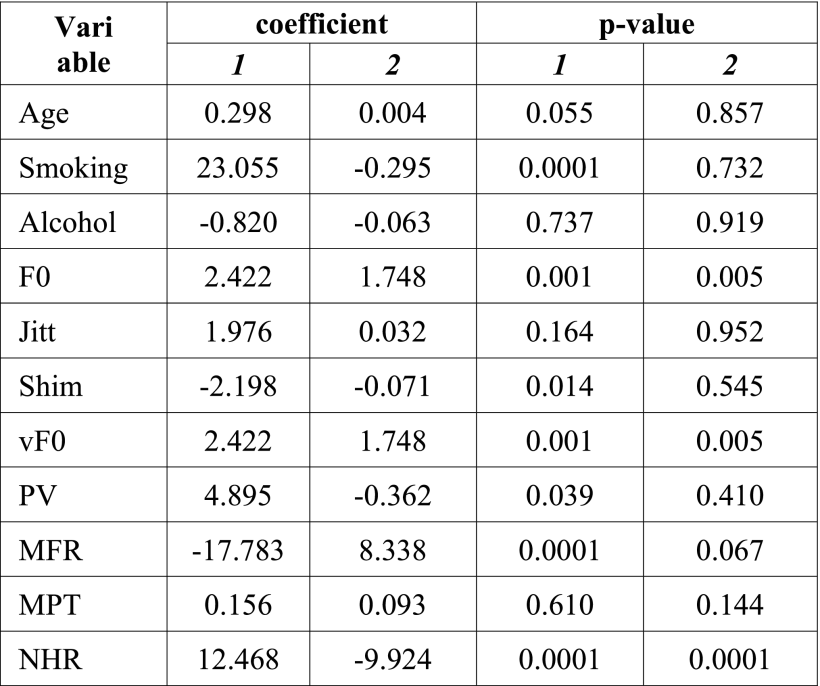
To identify additional predictive factors, multinomial logistic regression was conducted using three classes: healthy (reference), laryngeal cancer, and non-malignant voice disorder.
- Variables considered: patient age, smoking history, alcohol intake, and acoustic measures such as jitter, vF0, shimmer, MFR, NHR, etc.
- Results highlighted age, smoking, F0, vF0, MFR, NHR as most correlated with malignancy.
Multimodal Embedding
The selected metadata and acoustic parameters were embedded alongside MFCC in a composite input image:
- Base: 224×224 MFCC spectrogram placed centrally
- Surrounding tiles: embeddings of Age, Smoking, F0, vF0, MFR, NHR
- Continuous values binned into 10 categories before embedding
- Spatial arrangement positioned each variable consistently around the MFCC core
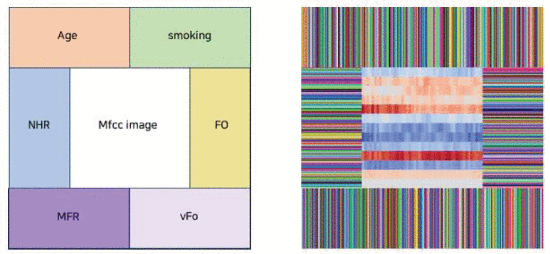
This composite image was then used as CNN input.
Models & Validation
- CNN (ResNet50 backbone) — pre-trained on ImageNet, modified with GAP, Dense(64), Dense(16), dropout (0.5 ×2), BatchNorm, ReLU, and final softmax
- Baselines:
- SVM (MFCC spectrogram input, balanced class weights)
- LightGBM (MFCC coefficient vectors, cancer weight=5)
- ANN (two hidden layers: 32, 8 units; MFCC vectors)
- Validation: 5-fold cross-validation
- Metrics: Accuracy, Precision, Recall, F1-score
Results
MFCC-only CNN vs Classical ML
CNN with MFCC input clearly outperformed other machine learning baselines.
| Model | Accuracy | Precision | Recall | F1 |
|---|---|---|---|---|
| CNN (ResNet, MFCC image) | 91.67% | 90.85% | 83.24% | 85.72% |
| SVM / LightGBM / ANN | Lower across all metrics | — | — | — |
Takeaway: CNN effectively captures disease-related spectral patterns from MFCC, exceeding traditional ML methods.
Impact of Multimodal Embedding
Embedding patient information and acoustic indicators alongside MFCC produced a dramatic performance gain.
| Input | Accuracy | Precision | Recall | F1 |
|---|---|---|---|---|
| MFCC-only | 91.67% | 90.85% | 83.24% | 85.72% |
| MFCC + (Age, Smoking, F0, vF0, MFR, NHR) | 99.69% | 99.69% | 99.51% | 99.60% |
Performance gain:
+8.0% in accuracy, +8.8% in precision, +16.3% in recall, +13.9% in F1.
Discussion
- Voice-only MFCC is a strong baseline but still limited by inter-patient variability and overlapping disease patterns.
- Embedding patient metadata and acoustic features creates a richer representation, allowing CNNs to learn joint patterns between clinical background and voice.
- This fusion boosted accuracy to near-perfect levels in cross-validation, showing that simple, clinically available information can dramatically improve AI-based screening.
- Practical implication: future diagnostic tools should not rely solely on voice spectrograms but instead leverage multimodal patient data for robust performance.