Jaemin Song, Hyunbum Kim, Seho Park & Yong Oh Lee
Scientific Reports, April 2024
Motivation
Laryngeal cancer incidence has declined with reduced smoking, but it still affects >10,000 patients annually in the U.S. and ~1,000 in South Korea.
Diagnosis is highly invasive, requiring a laryngoscope exam performed by a specialist in a hospital.
The most common and sometimes the only symptom is voice change, but despite its potential, voice has not yet become a standard biomarker. Why? Because:
- Voice is highly individual (influenced by sex, age, hormonal state, physiology).
- Voice varies with habits, environment, and emotional state.
- Multiple diseases (benign mucosal disease, vocal cord paralysis) cause voice changes similar to cancer.
However, the COVID-19 pandemic highlighted the urgent need for remote, non-invasive diagnostics.
AI-based analysis of voice has been tested in other conditions such as depression and Parkinson’s disease, proving feasibility.
Earlier attempts:
- Kim et al.: 1D-CNN using voice → 0.85 accuracy (healthy vs cancer).
- Kwon et al.: Fusion of laryngeal images + voice → 0.95 accuracy, but only 0.71 when using voice alone.
This study hypothesized that AI can classify not only healthy vs cancer, but also multiple laryngeal diseases using voice alone — a step toward practical voice-based cancer diagnostics.
Methods
Participants
- Total: 363 male patients (Jan 2015 – Dec 2022, Yeouido St. Mary’s Hospital).
- Groups: Healthy (155), Laryngeal cancer (30), Benign mucosal disease (81), Vocal cord paralysis (97).
- Exclusions: <19 years old, female, pregnant, prior surgery/radiation.
- Confirmation: All healthy confirmed by laryngoscopy.
- Pathology: All cancer = squamous cell carcinoma, mostly early stage.
Data Collection
- Recording device: Kay CSL (Model 5121), Shure SM48 microphone, digital amplifier.
- Setup: 10–15 cm distance, 90° angle, background noise < 45 dB HL.
- Sampling rate: 50,000 Hz.
- Task: sustained vowel /a/ for ≥4 s at 55–65 dB HL.
- Extra measures: aerodynamic parameters (phonatory aerodynamic system).
- Ethics: IRB-approved, retrospective study.
Feature Extraction: MFCC

- Voice segmented into 0.5 s intervals.
- Window length: 0.02 s; hop: 0.01 s.
- 13 MFCC coefficients extracted per segment → MFCC “images”.
Models
Main Deep Learning Model
- ResNet50 (pre-trained on ImageNet).
- Modifications:
- Global Average Pooling → Dense(64) → Dense(16).
- Dropout (0.5) ×2, BatchNorm, ReLU.
- Final dense layer = output classes.
- Input: MFCC image.
Comparator Models
SVM
- Input: MFCC image.
- Class_weight = “balanced” to address imbalance.
LightGBM
- Input: MFCC coefficient vectors.
- class_weight=5 for cancer, others=1.
ANN
- Fully connected layers with hidden sizes (32, 8).
- Input: MFCC coefficient vectors.
Validation
- 5-fold cross-validation.
- Metrics: Accuracy, Precision, Recall, F1-score.
Results
Participant Characteristics
- Average age: 52 years.
- Cancer group older, with significantly higher heavy smoking rate.
- Alcohol intake: not significantly different.
- Cancer pathology: 30 squamous cell carcinoma; mostly glottic; majority early-stage.
- Paralysis: mostly unilateral; only 1 bilateral case (required tracheostomy).
- Benign mucosal disease: included nodules, polyps, granulomas, Reinke’s edema.
Model Performance
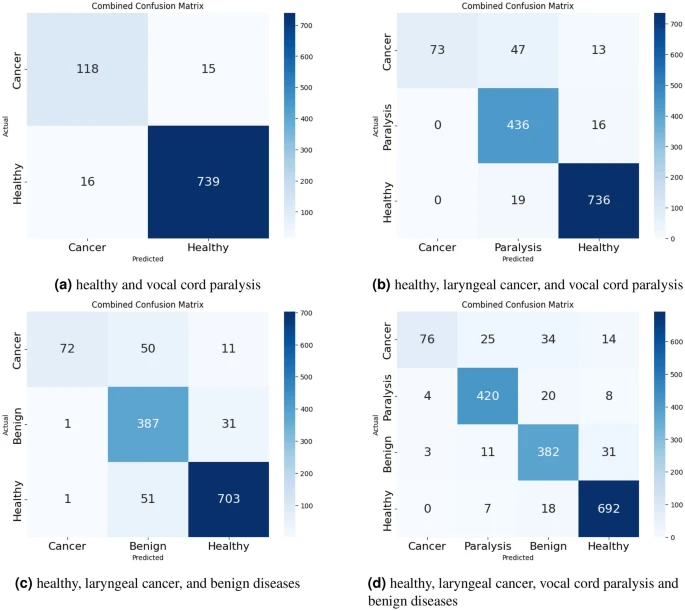
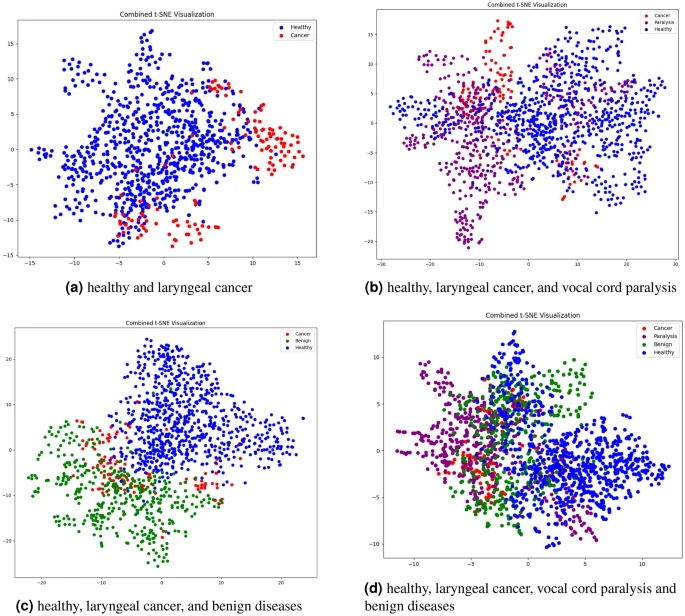
The study used t-SNE visualization on CNN feature maps to understand why classification accuracy declined when benign diseases were included alongside laryngeal cancer. The analysis showed that adding benign disease samples caused class features to overlap or cluster closely, reducing the model’s ability to clearly separate categories and thus lowering accuracy.
Discussion
- MFCC features with ResNet showed high accuracy in binary classification, proving feasibility for voice-based pre-screening.
- However, multi-class performance was weaker due to feature overlap — especially benign mucosal disease resembling healthy voices.
- Comparator models (SVM, LightGBM, ANN) confirmed the same trend: binary tasks easier, multi-class harder.
- These limitations highlight why MFCC alone may be insufficient, motivating later exploration of 1/3 octave band OFSE for finer low-frequency resolution.